

Workplace Stress: The Science Behind Prevention and Early Intervention
The various economic and industry challenges constantly bombarding our lives and work have resulted in unprecedented levels of stress. This is not only here in the United States, but around the developed world. Analysis published by the European Trade Union Institute suggests that workplace stress contributes to thousands of premature deaths across Europe annually. Harvard Business Review recently reframed employee stress not as an HR problem but as a core business risk. The result is that more reports of burnout, disengagement, and occupational mental health crises are surging across every industry.
For managers managing high-performing professionals, this reality demands more than sympathy; it demands strategy. The encouraging news is that psychological research now provides clear, evidence-based structures for understanding how stress develops, harms teams, and can be prevented from taking root.
The cost of ignoring this issue is staggering. Gallup State of The Global Workplace 2025 reported that in the United States, 67% of workers report feeling disengaged, and nearly half intend to leave their current job. When a disengaged employee quits, replacement costs range from 30% to 200% of that employee’s salary. For managers in competitive industries, these numbers represent a direct threat to team stability and performance.
My objective in this article is to cover the latest research on workplace stress, including timelines, the distinction between productive pressure and destructive strain, and a validated model for designing work that sustains engagement rather than erodes it. Whether you manage a team of five or fifty, these understandings will help you build a stronger, productive, and psychologically healthy team.
Understanding the Stress Timeline: What Research Tells Us
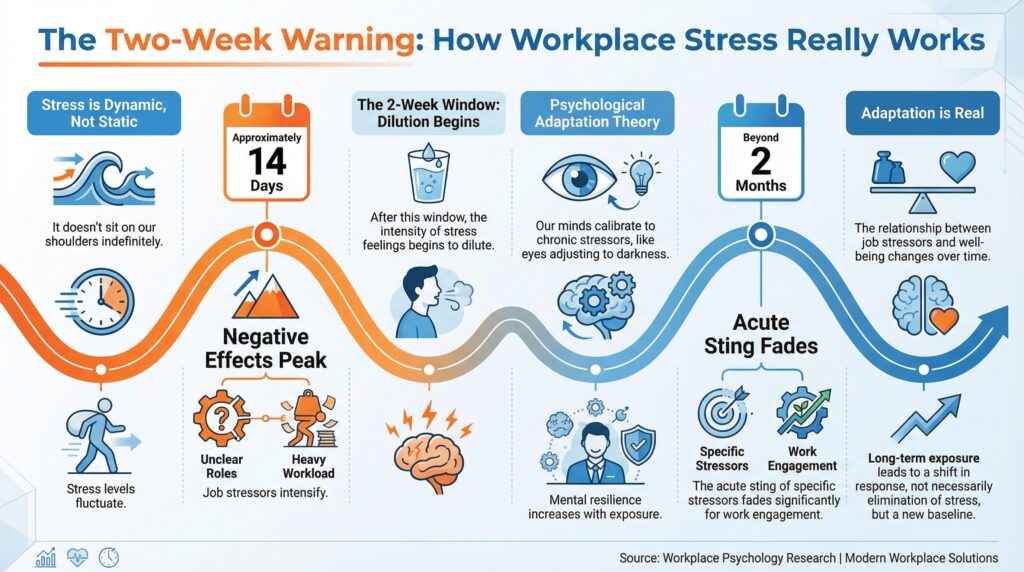
One of the most common misconceptions about workplace stress is that it’s a static weight sitting on an employee’s shoulders until something changes. In reality, stress is remarkably dynamic. A rigorous longitudinal study tracking over 100 full-time workers across an entire year has mapped the emotional metabolism of professional pressure with striking precision.
The researchers found that most workplace stressors, such as ambiguous expectations, overwhelming workloads, and interpersonal conflicts, have a negative impact that peaks approximately 14 days after initial exposure. After this two-week window, distress begins to dilute as psychological adaptation takes hold. By roughly the two-month mark, the acute sting of a specific stressor fades considerably.
This timeline carries far-reaching implications for managers and their organizations. Basically, a critical intervention window is limited to the first two weeks after a new stressor. During this time, it represents your greatest opportunity to provide support before negative patterns become permanent. Employees who express the urge to quit after an especially difficult week may benefit most from your steady presence and reassurance, not from reactive scrambling.
A more extensive systematic review of 71 articles reinforces and extends these outcomes by revealing that different stressors operate on essentially different timelines. Among the most pervasive workplace stressors, workload, emotional demands, and time pressure, the clocks vary dramatically.
Time pressure behaves like a sprinter, producing immediate exhaustion that can vanish and then re-emerge months later in a roller-coaster trajectory. In contrast, workload and emotional demands behave like marathon runners, with their full consequences often not felt until weeks or months later. This explains a phenomenon many managers have witnessed: an employee who handles a crisis with extraordinary composure, only to crash once the dust settles. The damage was accumulating under the surface, a phenomenon researchers have termed the “sleeper effect.”

Not All Stress Is Created Equal
Understanding the stress timeline becomes even more powerful when combined with research on workplace stressor categories, because the type of stress your team experiences determines both its consequences and your optimal response.
Productive pressure, sometimes called challenge stress, is the kind that drives people to work hard toward significant goals. Employees experiencing this type of stress often say they’re under pressure, but they’re clearly engaged and energized. As a manager, learning to differentiate between productive pressure and destructive strain is one of the most important skills you can develop, because strategically applied pressure can actually boost team performance.
The Two Forms of Destructive Stress
Destructive stress takes two distinct forms, each calling for different managerial responses. The first involves role stressors defined as conflicting demands, unclear expectations, and task overload.
Ambiguity acts like a sudden puncture to team engagement, deflating motivation almost instantly, with the peak impact occurring around day seven. When employees don’t understand what’s expected of them, their ability to enter a productive, rewarding work state drops sharply.
The second and more dangerous form involves what researchers call illegitimate tasks. This is work that feels unreasonable, unnecessary, or fundamentally inconsistent with an employee’s professional identity. For example, a senior engineer performing administrative tasks is clearly out of their role, or a team member completing paperwork that everyone knows will never be reviewed. These tasks trigger a psychological withdrawal response significantly stronger than the effects of role conflict or simple overload. The data clearly demonstrates that illegitimate tasks are the fastest route to a resignation letter.
There is also a sleeper pattern associated with chronic overload. Unlike the acute sting of unfair task assignments, the pressure of sustained high volume accumulates slowly and silently. Its impact on turnover intention often doesn’t emerge significantly until after two months, and by the time it surfaces, the opportunity for easy intervention has passed.
The “Ideal Employee” Paradox
Perhaps the most counterintuitive finding for managers of top-performing teams is that the very traits organizations prize most can accelerate burnout. A systematic review of burnout timelines identified a troubling paradox: workaholism, deep passion for one’s work, and meticulous, comprehensive planning were all linked to higher levels of daily exhaustion. These characteristics undeniably drive outstanding performance, but the sustained cognitive and emotional effort they demand gradually depletes an individual’s energy reserves in ways that neither the employee nor their manager may notice until the damage is done.
For managers leading ambitious, driven teams, this finding is a critical warning. Your most dedicated employees, the ones who volunteer for extra projects, who stay late perfecting their work, who seem to thrive on intensity, may be the ones most quietly at risk. Monitoring their workload and recovery with particular care is not micromanagement; it is an essential responsibility. The employees who appear to need the least support are often the ones who need it most.

When Stress Goes Unaddressed: Fight or Freeze
A multiyear leadership study spanning more than 150 senior leaders found that when workplace stress escalates without intervention, employees typically shift into one of two coping modes.
In the fight response, employees double down on performance, obsessively fixating on output and colleagues’ apparent shortcomings. Neurologically, elevated stress triggers cortisol release related to emotional dysregulation and heightened aggression, producing interpersonal tension and combative communication that fractures team unity.
In the freeze response, employees withdraw, staying silent in meetings, disconnecting from interactions, and pulling back emotionally. In this case, chronic stress disrupts serotonin and other mood-related neurotransmitters, deepening this withdrawal. Leaders often misread this as apathy, further isolating the employee.
Both responses are self-reinforcing: fight behavior drives peers away, freeze behavior invites neglect, and each spiral erodes the team’s capacity to function. Most employees cycle through temporary episodes that resolve naturally, but chronic stress can harden these coping responses into permanent psychological harm.
Designing Work That Stops Burnout
Grasping the dynamics of stress is essential, but prevention is always more effective than intervention. This is where work design becomes a critical managerial competency. Too often, managers respond to burnout with “fix-the-worker” strategies, such as productivity tips, boundary-setting encouragement, or stress-reduction workshops.
At times, these efforts can fall short. Although it is true that person-directed interventions can help with acute, short-term stressors, such as daily time pressure, they cannot prevent slow-burning stressors that accumulate over weeks and months, such as chronic workload, emotional demands, and poorly designed roles. Only organization-directed changes to the work itself will prevent the long-term crash.
A more effective approach is to design work that sustains engagement and well-being from the ground up. The SMART Work Design model, developed through extensive research including global surveys and longitudinal validation, synthesizes decades of organizational psychology into five critical dimensions that predict both worker well-being and performance. The model has been confirmed by manager-rated performance assessments, confirming that well-designed work leads to quantifiable improvements in output rather than just employee satisfaction.
Stimulating Work
Jobs that provide task variety, skill development, and meaningful problem-solving support engagement. When work becomes highly repetitive with no growth opportunities, motivation erodes. Managers should ensure each role includes enough variety and challenge to keep people intellectually engaged.
Mastery
Employees perform best when they understand their roles clearly, receive regular feedback, and see how their work connects to the bigger picture. This directly addresses the role ambiguity identified by research as a prompt engagement killer. Ensure expectations are crystal clear and every team member understands the “why” behind their assignments.
Autonomy
Workers who have appropriate control over when and how they work develop a feeling of ownership that drives creativity and sustained effort. Autonomy has to match the employee’s level of mastery. A new team member needs more guidance, while an experienced professional thrives with greater independence.
Relational Work
Teams that offer social support, meaningful collaboration, and a sense of making a difference are inherently more resilient. Employees who are supported by their boss and peers cope better under pressure, while isolation contributes to loneliness and withdrawal, a more urgent concern in hybrid and remote work. However, poorly delivered support can backfire: when help threatens an employee’s sense of competence, it can trigger inadequacy rather than relief. Frame support as collaborative problem-solving, not a rescue mission.
Tolerable Demands
Even well-designed work turns unsustainable when demands exceed a manageable threshold. Excessive overtime, conflicting priorities, or workplace hostility overwhelm coping capacity. Ensuring demands remain tolerable is one of the most powerful levers for preventing burnout. The sleeper effect means chronic overload may show no warning signs for months before surfacing as turnover or performance decline.
These five dimensions are deeply interrelated. Heavy workloads appear more manageable when employees have autonomy and strong peer support. Stimulating work sustains engagement even during demanding periods. The framework works best when all five dimensions are assessed and addressed together.
Useful Strategies for Day-to-Day Management
Understanding the research is valuable, but translating it into regular management practice is what makes the difference. Maintain radical transparency during organizational change by holding regular meetings that break down corporate decisions into concrete local implications.
Be encouraging but sensible, since false reassurance erodes trust faster than difficult truths.
Build genuine psychological safety by establishing emotional integrity, where employees trust that their concerns will be taken seriously rather than dismissed as weakness, and by developing “microclimates of trust” where team members perceive themselves as responsible for each other’s well-being.
Clarify the purpose of every assignment, especially tasks tangential to an employee’s core role. Since illegitimate tasks are the single strongest driver of turnover, never assume your team sees the connection between a seemingly unreasonable request and the larger goal.
Keep your antenna up by deliberately checking in when someone appears stressed. Keep in mind the two-week stress peak means that by the time a concern is formally raised, the employee has already been struggling for days.
Resolve interpersonal conflicts early by depersonalizing disagreements and identifying common ground, and when a genuinely toxic team member refuses to change, recognize that the price of inaction in terms of morale and retention is far higher than most managers realize.
Protect recovery time by encouraging staff to leave on time, take real breaks, and fully disconnect on vacation, and model this behavior yourself, because sending midnight emails pressures your team regardless of what you say.
Finally, invest in job crafting as a collaborative conversation in which employees reshape their responsibilities to match their strengths and career goals, whether that means leading a new initiative or restructuring an unsustainable workload.

The Leader’s Role: Amplifier or Buffer?
Every strategy in this article is grounded in a sobering finding from a multiyear leadership study: the very leaders tasked with modeling resilience frequently end up increasing their team’s stress instead. Rather than easing pressure, their behaviors frequently intensify it, weakening the very team unity and performance they are trying to protect.
In one professional services firm studied, a new director brought a controlling, confrontational leadership style that introduced few actual procedural changes. Yet the erosion of trust was so severe that absenteeism spiked, engagement collapsed, and 75% of the team resigned within 18 months. Many sought counseling to recover from the emotional toll.
The pattern is more common than most leaders want to admit. When performance slips, the instinct to increase pressure often backfires. Leaders under their own unmanaged stress may default to counterproductive coping, aggression, excessive control, or emotional withdrawal that destabilizes the team. A leader’s self-regulation starts with awareness: identifying your stress triggers, recognizing how your reactions affect others, and building habits like mindfulness, exercise, and engagement with peers or coaches to maintain perspective.
Beyond managing their own stress, effective leaders actively expand their team’s capacity to navigate pressure, which researchers describe as “expanding the band” of high functionality. Leaders do this by strengthening employees’ coping skills through coaching, changing how employees perceive stress through clear communication and fair expectations, and buffering structural sources of pressure, such as rigid deadlines and conflicting priorities. Build work design into your regular management rhythm: put it on the weekly agenda and conduct check-ins focused on how work feels, not just what’s getting done.
Taking the Next Step
Creating a low-stress, high-performance team requires more than good intentions; it requires a systematic approach based on evidence-based psychological principles. The research is clear: the difference between teams that flourish under pressure and teams that fracture comes down to how intentionally their work is designed and how skillfully their leaders respond to inevitable stressors.
Dr. Ginny Estupinian is a board-certified clinical psychologist (ABPP) who specializes in helping corporate leaders and organizations in Silicon Valley and throughout the country build psychologically healthy, effective teams. Through individual executive consultation, team-level assessments, and customized corporate programs, Dr. Estupinian partners with managers and leadership teams to identify the specific stress dynamics affecting their personnel and execute targeted, evidence-based interventions that produce lasting results.
Whether you are navigating organizational change, addressing burnout on a specific team, or building an active stress-prevention strategy, Dr. Estupinian’s programs are designed to meet you where you are. In this article, she has provided a broad overview of the subject, but Dr Estupinian always tailors her program to meet the demands of each organization she works with. Her approach unites the rigorous, research-backed frameworks with the clinical expertise necessary to confront the complex human dynamics that no framework alone can entirely capture.
To learn more about corporate consultation and the various stress management programs, click here or contact Dr. Estupinian’s office at 844-802-6512 to schedule a consultation.
Frequently Asked Questions About Workplace Stress Management
How long does workplace stress last after a stressful event?
Research tracking employees over a full year found that the negative impact of most workplace stressors peaks approximately 14 days after initial exposure. After this two-week window, psychological adaptation begins, and distress gradually diminishes. By the two-month mark, the acute effects of a specific stressor have typically faded considerably. However, different types of stressors follow different timelines—time pressure produces immediate exhaustion, while workload and emotional demands may not fully manifest for weeks or months.
What is the difference between good stress and bad stress at work?
Productive stress, also called challenge stress, drives employees to work hard toward meaningful goals. People experiencing it feel pressured but energized and engaged. Destructive stress, by contrast, overwhelms employees’ coping capacity. It takes two primary forms: role stressors (conflicting demands, unclear expectations, and overload) that deflate motivation, and illegitimate tasks (work that feels unreasonable or beneath an employee’s role) that trigger psychological withdrawal and significantly increase turnover intention. The critical skill for managers is learning to distinguish between the two.
What are illegitimate tasks, and why do they cause employees to quit?
Illegitimate tasks are assignments that feel unreasonable, unnecessary, or fundamentally misaligned with an employee’s professional identity—such as a senior engineer being asked to handle administrative work clearly beneath their expertise. Research shows these tasks trigger a stronger withdrawal response than role conflict or simple overload because they offend an employee’s sense of professional worth. The data identifies illegitimate tasks as the single strongest driver of turnover intention, making them more damaging than heavy workloads alone.
What is the sleeper effect in workplace burnout?
The sleeper effect describes how certain types of workplace stress accumulate silently beneath the surface before producing visible symptoms. Unlike time pressure, which causes immediate exhaustion, chronic workload and emotional demands may show no obvious warning signs for weeks or months. An employee may appear to handle a crisis with composure, only to crash after it ends. The sleeper effect makes chronic overload particularly dangerous because managers often miss the building damage until it surfaces as turnover, burnout, or performance decline.
What is the SMART Work Design model?
The SMART Work Design model is a research-validated framework that organizes the most important work characteristics into five dimensions: Stimulating work (task variety and skill development), Mastery (role clarity and feedback), Autonomy (control over how and when work is done), Relational work (social connection and support), and Tolerable demands (manageable workload and reasonable expectations). The model helps managers diagnose which aspects of work design are contributing to disengagement or burnout and take targeted action to improve both employee well-being and performance.
Why don’t wellness programs and mindfulness training fix burnout?
Wellness programs and mindfulness training are examples of what researchers call “fix-the-worker” strategies. While they can help employees manage acute, short-term stressors like daily time pressure, they do little to address the structural causes of burnout—chronic workload, poorly designed roles, unclear expectations, or illegitimate tasks. Research on burnout timelines shows that slow-burning stressors require organization-directed changes to how work itself is structured, not just individual coping tools. Effective burnout prevention combines both approaches, prioritizing work design.
What are fight and freeze responses to workplace stress?
When stress escalates without intervention, employees typically shift into one of two coping modes. The fight response involves obsessive focus on performance, impatience, hypercompetitiveness, and combative communication driven neurologically by elevated cortisol. The freeze response involves withdrawal from meetings, silence in discussions, and emotional disconnection linked to disruptions in serotonin and other mood-related neurotransmitters. Both are self-reinforcing: fight behavior alienates colleagues, freeze behavior invites neglect, and each cycle erodes team functioning. While temporary episodes are normal, chronic stress can harden these responses into lasting psychological harm.
How can managers tell if an employee is struggling with stress?
Watch for behavioral changes rather than waiting for employees to self-report. Signs of a fight response include increased irritability, perfectionism, difficulty collaborating, and working excessive hours. Signs of a freeze response include withdrawal from meetings, uncharacteristic silence, missed deadlines, and emotional detachment. As stated above, the critical intervention window is the first two weeks after a new stressor. So, proactively checking in during this period, ideally in an informal setting like a coffee outside the office, is far more effective than waiting for a formal conversation.
Can a manager’s leadership style cause employee burnout?
Yes. A multiyear study of leadership behavior across more than 150 senior leaders found that leaders tasked with modeling resilience often amplify stress instead. Controlling, confrontational, or emotionally detached leadership erodes trust and makes it harder for employees to manage both workplace and personal pressures. In one documented case, a single leader’s toxic management style caused 75% of a team to resign within 18 months. Leaders who fail to manage their own stress often default to aggression, excessive control, or withdrawal—behaviors that destabilize their teams.
What does “expanding the band” of functionality mean for teams?
The concept describes expanding the zone in which employees remain emotionally engaged and cognitively effective despite pressure. Leaders expand this band through three strategies: strengthening employees’ coping skills through coaching, reshaping how employees perceive stress through clear communication and fair expectations, and buffering structural sources of pressure, such as rigid deadlines and conflicting priorities. The goal is not to eliminate stress but to increase the team’s collective capacity to navigate it without tipping into fight-or-freeze responses.
What is psychological safety, and how does it reduce workplace stress?
Psychological safety is a climate where employees trust that they can raise concerns, admit difficulties, and share their emotional experiences without fear of judgment or retaliation. Research on team resilience shows it must go beyond an open-door policy to include “emotional integrity”—where people believe their experiences will be taken seriously. The most resilient teams develop “microclimates of trust” where team members feel responsible for each other’s well-being, making resilience a shared function rather than an individual burden.
Why are high-performing employees at greater risk of burnout?
Research reveals a counterintuitive paradox: traits organizations prize most—workaholism, deep passion for work, and meticulous planning—are linked to higher levels of daily exhaustion. These characteristics drive outstanding performance, but the sustained cognitive and emotional effort they demand gradually depletes energy reserves in ways neither the employee nor their manager may notice. Employees who volunteer for extra projects, stay late perfecting work, and seem to thrive on intensity are often the ones most quietly at risk of burnout.
What is job crafting, and how does it reduce stress?
Job crafting is a bottom-up approach where employees, in partnership with their manager, reshape their responsibilities to better align with their strengths, interests, and career goals. It might involve giving someone who needs more intellectual stimulation the opportunity to lead a new initiative, or restructuring task delegation for someone with an unsustainable workload. Unlike top-down restructuring, job crafting occurs through collaborative conversation and improves both job satisfaction and stress levels.
How can managers prevent stress during organizational change?
Transparency is the most effective tool. Employees become stressed when kept in the dark, and during change, rumors and uncertainty amplify anxiety far beyond the actual impact. Managers should hold regular meetings explaining what is happening and how it specifically affects their team’s day-to-day work. The critical skill is decoding high-level corporate decisions into concrete local implications. Additionally, managers should proactively clarify the purpose behind any new or shifting assignments to prevent them from being perceived as illegitimate tasks, which are the strongest driver of turnover.
When should a company bring in a psychologist to help with workplace stress?
Organizations should consider professional consultation, such as Dr Ginny Estupinian, when they observe patterns of elevated turnover, chronic absenteeism, declining team performance, or signs of widespread fight-or-freeze behavior across a team or department. Ginny Estupinian, PhD, a board-certified clinical psychologist who specializes in corporate consulting, can conduct team-level assessments, identify the specific stress dynamics at play, and design targeted interventions that address root causes rather than symptoms. This is particularly valuable during periods of organizational change, after the departure of a toxic leader, or when internal efforts to address burnout have not produced results.